

Ethiopia Ancient Civilizations
There are places which murmur history and there is Ethiopia, which not only speaks it but also sings it and even screams it down the mountainsides. Coming here is not so much a sightseeing mission; it is a time journey. Through rock-cut churches, or perhaps standing in the shade of ancient stelae, you do more than gather facts: you walk centuries off your feet. The Ethiopia ancient civilizations do not lie buried under dusty books but live on and breathe life into the daily lives of people around.
Continuity is what makes Ethiopia so strong. This is not one of those nations that is attempting to forget its history – it never forgot it. To understand that Ethiopia ancient history leads to the present is to see everything differently.
Key Insights from Ethiopia Ancient Civilizations
1. Where It All Began: The Cradle of Humanity
Let’s start big. Really big. For what the rest of the world calls Ethiopia-the cradle of humanity-is not poetical. The fossils of Lucy remind us that history of ours as beings never started in marble halls and golden palaces but right here. There is no way to know how deep those roots are without understanding the history of Ethiopia.
Ethiopia ancient civilizations were early in coming up with regimes of governance, farming and faith long before the establishment of modern borders or the establishment of empires. Neither were these societies closed ones, however; they engaged in trade with Egypt, Arabia and so forth. That initial international relationship is evident to this day and is embedded in language, cuisine and religion.
2. The Aksumite Empire: Power Carved in Stone
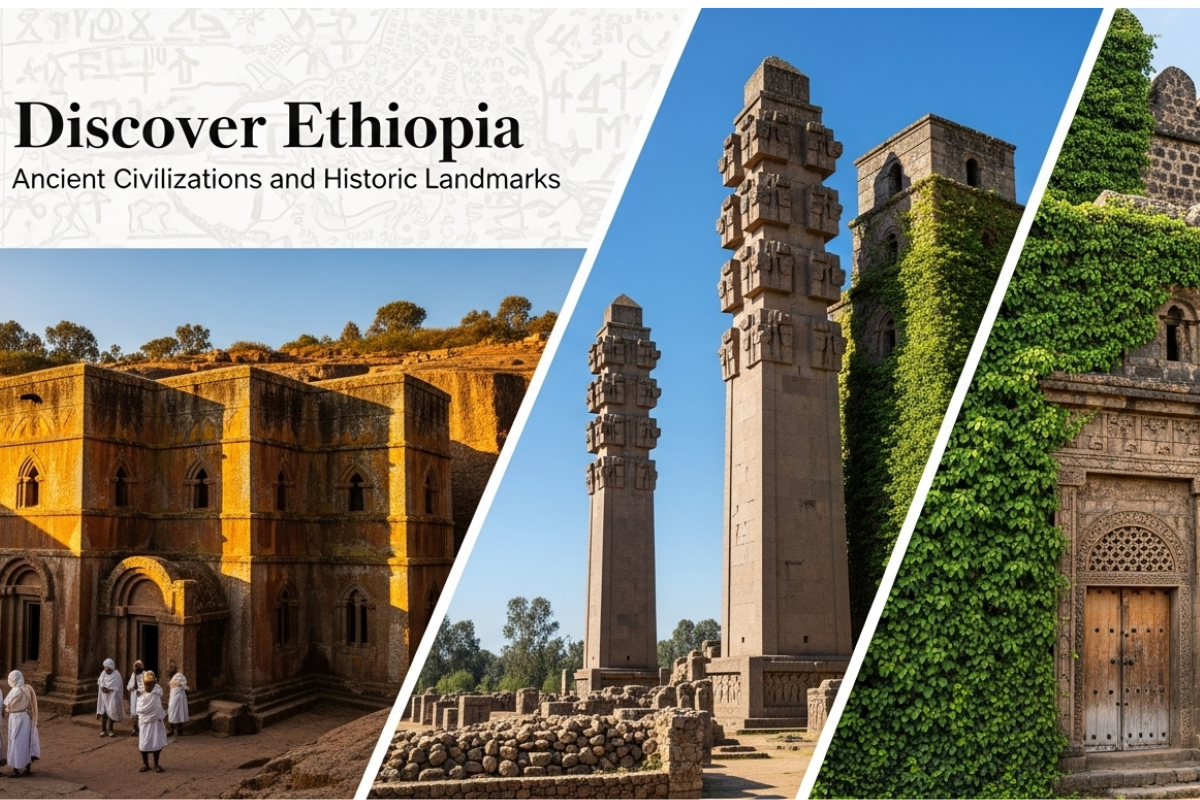
Aksum is one of those civilisations which historians find truly-eureka. During the Aksumite empire, trade in gold and ivory was done and the coins were also produced in that territory. Those standing obelisks? They are not mere dramatic photo opportunities, but they are declarations of power.
These Ethiopia monuments make one feel small as one walks amongst them. This is Ethiopia ancient civilizations stretching their architectural muscles and demonstrating that they were on the same platform as Rome and Persia. And honestly? They held their own just fine.
3. Lalibela: Faith Chiseled from the Earth
So, now we are going to discuss Lalibela, as no Ethiopia landmarks are complete without it. Eleven churches, hewn out of volcanic rock. No bricks. No mortar. Faith that is just, and instruments, and amazing patience.
When standing there you can feel the spiritual beat of the Ethiopia heritage. Pilgrims take days to worship, as was the case several centuries ago. It is one of those few in which Ethiopia ancient civilizations do not feel old at all; they feel alive.
And it is all right if you are dropping your jaw. Everyone does.
4. Gondar and the Royal Story
Blink and you miss Ethiopia, which is made of rock churches and ruins. Gondar politely disagrees. This city is the so-called Camelot of Africa and is full of castles that appear to have strayed through Europe and then found their place.
These royal complexes bring another dimension to the history of Ethiopia, as they indicate how Ethiopia ancient civilizations transformed, as opposed to becoming extinct. There was a change of power, styles changed, yet identity was not lost. Gondar is convinced that Ethiopia is not a type of book, but a library.
5. Harar: Walls, Stories, and Living History
Now you enter its walls, and Harar is different. Alleys are very narrow, markets buzz and history is very tangible. It is the city of cultural hedonism and the Ethiopia heritage that cannot be caught in time.
In this case, Ethiopia ancient civilizations are expressed through poetry, commerce, and rituals. It is not too glamorous, yet it is very, very human – it is what makes it memorable.
The Spiritual Backbone
Religion in Ethiopia is not only belief but also architecture, art and rhythm. Ethiopian Orthodox Christianity has produced a myriad of Ethiopia landmarks, in the form of monasteries sitting atop cliffs as well as manuscripts coloured and painted with devotion.
Another fact that makes Ethiopia ancient civilizations unique is this spiritual continuity. Most of the ancient cultures were lost or broken, but the Ethiopian views on life survived. Religion here is not a thing that is inherited but experienced.
Why Ethiopia Ancient Civilizations Feels Different
The point is that most countries have ruins. Ethiopia has memories. The Ethiopian monuments are not stand-alone events, but they are still chapters of a story that did not cease being told. Since time immemorial, the thread has been continuous through old kingdoms to present-day cities.
There is an intimacy to the experience of the Ethiopia ancient civilizations. You are, after all, not a passive bystander in history; you are walking in the middle of it. The past doesn’t murmur at you from afar; it confronts you defiantly, corporeal, and unexpectedly stirring.
Traveling Through Time (Without Feeling Like a Tourist)
The past is so close to Ethiopia that it is one of its delights. The locals do not regard such places as relics, but they regard them as family members. That cosiness causes learning about Ethiopia ancient history to be not so academic but rather emotional.
You will listen to generations-old myths, taste recipes that are even older than the country itself, and observe traditions that do not go away. People are the continuation of Ethiopia ancient civilizations and not plagues.
Final Thoughts: Why Ethiopia Stays With You
Ethiopia makes no effort to impress you; it is. And that’s its power. The images still haunt you long after you have gone: Rock churches in the morning sun, old walls vibrating with prayer and the silent thought that Ethiopia ancient civilizations contributed to the creation of the world more than most people appreciate.
And when you are willing to dive into this richness with a sense of inquiry and comfort, mindful cultural touring activities via Viator may assist in transforming interest into attachment, without losing that feeling of wonder.
For more guides on city wonders, travel hacks, and unforgettable tours, visit Stayluxehotels.
About the Author